
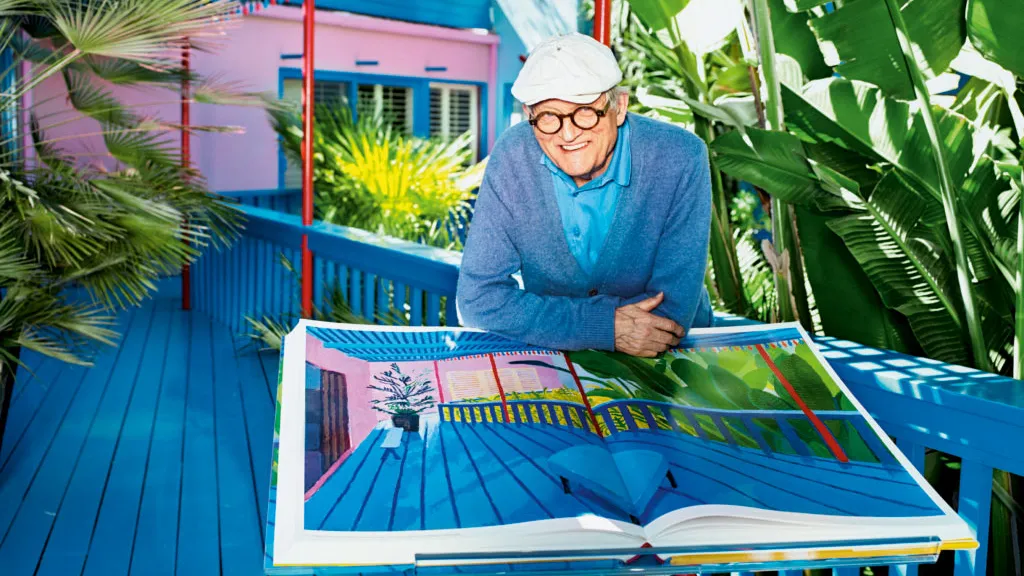
How One Artist Turned Style Into a Way of Living
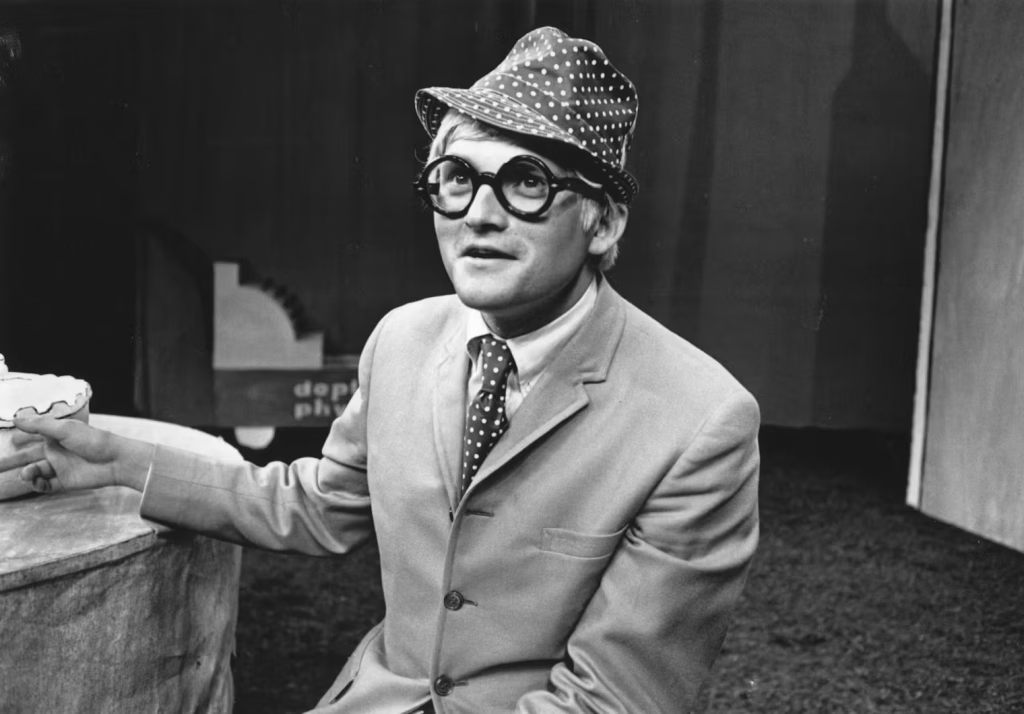
There are artists who create paintings.
And then there are artists who quietly change the way we look at the world.
David Hockney belonged to the second category.
The celebrated British artist, who passed away at the age of 88, spent more than seven decades teaching the world not simply how to observe color, landscape, intimacy, and desire — but how to see them differently. His death marks not only the loss of one of contemporary art’s most recognizable figures, but the closing of a visual language that helped redefine modern perception itself.
To describe Hockney merely as a painter would be insufficient. He was a visual philosopher disguised as an artist — moving effortlessly between painting, photography, opera, drawing, digital experimentation, portraiture, and stage design while maintaining an unmistakable creative voice. Whether through acrylic swimming pools glowing beneath the California sun, intimate portraits, Yorkshire landscapes, or drawings created on an iPad, Hockney remained obsessed with one fundamental question: how do human beings truly experience reality?
Few artists succeeded in making color feel emotional in the way Hockney did.
His iconic Los Angeles swimming pools never represented luxury alone. They represented longing. Movement. Heat. Solitude. Desire. In works such as A Bigger Splash, sunlight became architecture, silence became narrative, and water itself transformed into emotion. California, through Hockney’s eyes, ceased to be geography and instead became atmosphere.

Yet perhaps what made Hockney extraordinary was not simply what he painted — but how fearlessly he evolved.
Many artists spend their later years protecting a legacy. Hockney spent his expanding it.
Long before digital creativity became fashionable, he embraced technology as part of artistic expression, producing works on iPhones and iPads with the same seriousness he once reserved for charcoal and canvas. While much of the art world debated whether digital creation could be legitimate, Hockney simply continued making work. Curiosity, for him, was always stronger than nostalgia.
His work also carried something quietly revolutionary: visibility.
As an openly gay artist during decades when queer identity remained marginalized, Hockney placed intimacy, companionship, tenderness, and same-sex love directly inside the visual language of fine art. Without spectacle or apology, he expanded who could be seen — and celebrated — within contemporary culture. What now feels natural once required enormous creative courage.
And perhaps that is why David Hockney always felt strangely contemporary.
He understood something many creators forget: style is not decoration. Style is a way of understanding life.
His round glasses, tailored jackets, cardigans, cigarettes, playful colors, and unmistakable visual presence were never performance. They reflected a philosophy — one where beauty belonged not to perfection, but to attention. To truly look at the world was, in many ways, an act of resistance.

Only last year, Paris hosted one of the most significant retrospectives of his career at Fondation Louis Vuitton, gathering hundreds of works spanning decades of experimentation and artistic transformation. It served not as a retrospective of nostalgia, but as proof that Hockney never stopped evolving.
In a cultural moment increasingly defined by speed, algorithms, and visual overload, Hockney reminds us of something unexpectedly simple:
To see deeply is still radical.
And perhaps this will remain his greatest legacy — not only the paintings, the portraits, or the swimming pools, but the invitation to slow down and notice the world more carefully.
Because for David Hockney, art was never only about appearances.
It was about learning how to look.
David Hockney never belonged to a single era.
He painted California but carried Yorkshire with him. He embraced the iPad without abandoning drawing. He understood fashion without ever appearing interested in fashion itself. And perhaps this is precisely why his work continues to feel alive: it never tried to follow culture — it quietly moved ahead of it.
At QEditorial Magazine, we believe the most important creative figures are often those who change not simply what we see, but how we see. Hockney’s work reminds us that beauty still lives in observation, that color can hold memory, and that personal style — whether in art or life — begins with attention.
In a world increasingly shaped by speed and distraction, David Hockney leaves behind something unexpectedly radical:
The invitation to slow down and truly look.


Leave a Reply